
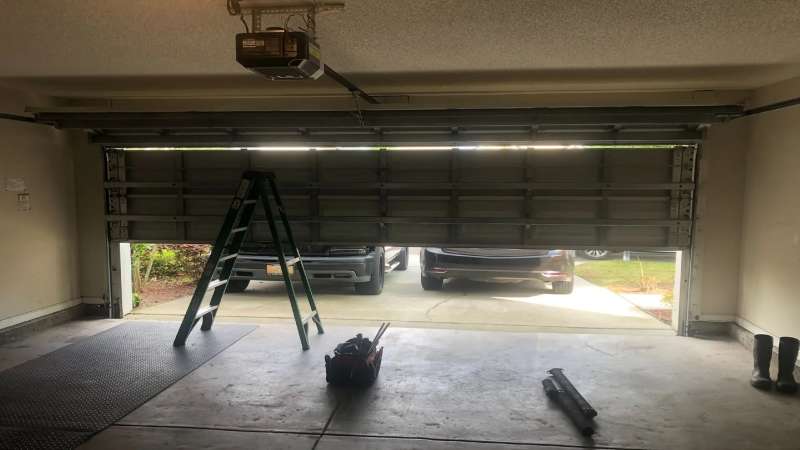
Your garage door system is one of the most complex mechanical systems in your home or business — and one of the most used. It opens and closes thousands of times a year, handles weather, provides security, and for most households serves as the primary daily entry point. When something isn’t right, you need a provider who can address any part of the system, not just one specialty.
America’s Garage Doors provides a comprehensive range of residential and commercial garage door services — from routine maintenance and weatherstripping replacement to full new installations, opener upgrades, spring service, and emergency repairs. This guide walks through every service category so you know exactly what’s available, when each service applies to your situation, and what to expect.
1. Residential Garage Door Services
Residential garage door service covers the full lifecycle of a homeowner’s door system — from the first installation through decades of maintenance, repairs, and eventual replacement. For most households, the garage door is the most-used mechanical system in the home, cycling open and closed multiple times every day. Getting it right — and keeping it right — is what residential service is built around.
What residential service encompasses:
- New door installation: Selection guidance, accurate measurement, and professional installation with full safety testing and homeowner walkthrough.
- Ongoing maintenance: Scheduled inspection, lubrication, hardware tightening, balance testing, and safety system verification.
- Repairs: From minor hardware adjustments and roller replacement to panel repair, track realignment, and cable service.
- Opener service: Repair or replacement of opener systems, including upgrades to smart connectivity and battery backup.
- Component replacement: Springs, cables, rollers, hinges, weatherstripping — individual component service as needed.
The residential service relationship is at its best when it’s proactive rather than reactive. Homeowners who schedule annual professional inspections and address small issues early spend significantly less over the lifetime of their door system than those who call only when something has failed.
2. Commercial Garage Door Services
Commercial overhead doors serve fundamentally different requirements than residential garage doors. They are larger, heavier, subjected to significantly more cycles, and carry operational and safety compliance obligations that residential doors don’t. A loading dock door that fails during business hours isn’t an inconvenience — it’s an operational stoppage with direct financial consequences.
What sets commercial service apart:
- High-cycle hardware: Commercial springs and operators are rated for 100,000+ cycles in demanding applications, compared to 10,000 cycles for standard residential components. Using residential-grade parts in a commercial setting leads to rapid failure.
- Operator power and duty cycle: Commercial operators handle heavier door weights and higher daily cycle counts than residential openers. Three-phase electrical connections are common in heavy commercial applications.
- Access control integration: Card readers, keypads, vehicle detection loops, intercom systems, and building management integration are standard commercial requirements.
- Safety and code compliance: Commercial doors in workplaces must meet OSHA requirements and local building codes, including entrapment protection, safety edges, and warning signage.
- Preventative maintenance programs: Commercial properties with multiple doors benefit from scheduled maintenance contracts that include regular inspection, lubrication, safety testing, and priority emergency response.
3. Garage Door Installation
A new garage door installation is one of the highest-ROI home improvements available, consistently returning over 90% of its cost in added home value while delivering immediate improvements in appearance, energy efficiency, security, and daily convenience. The installation decision involves material selection, sizing, insulation, style, and opener choice — all of which compound over the door’s 15–25 year service life.
Key installation decisions:
- Material: Steel is the most practical all-around choice — durable, low-maintenance, and available in insulated versions. Wood delivers character but requires ongoing maintenance. Aluminum is rust-resistant and suits modern and coastal applications. Composite offers wood aesthetics with better moisture resistance.
- Insulation: R-12 or higher for attached garages. Triple-layer doors with polyurethane foam cores chemically bonded to both steel skins outperform double-layer polystyrene-backed doors at equivalent R-values.
- Style: The door accounts for up to 40% of the home’s front facade. Matching the style to the home’s architecture — raised panel, carriage-house, contemporary flush — creates cohesion that directly impacts curb appeal.
- Sizing: Plan for the vehicles and uses you may have in five years, not just today. Widening a garage opening after the fact is a major structural project.
What professional installation includes: Pre-installation measurement, old door removal and disposal, panel and track installation to manufacturer specifications, spring tensioning, cable installation, opener mounting and programming, and a complete safety inspection before handover.
4. Garage Door Repairs
Garage door repair addresses the full range of issues that develop over a door’s service life. The central principle of quality repair service is whole-system assessment — addressing the visible problem while identifying its root cause and any other components it has affected. A repair that fixes the symptom without the cause leads to another service call within months.
Common repair needs:
- Panel repair or replacement: Individual panels dented by impact can often be replaced without replacing the entire door, provided matching panels are available and the frame is structurally sound.
- Track realignment: Bent or misaligned tracks cause binding, uneven movement, and eventually off-rail failures. Stop operating a door with a compromised track immediately.
- Roller replacement: Worn steel rollers grind against the track and accelerate wear. Upgrading to nylon rollers at replacement time reduces noise and extends the service interval.
- Hardware tightening: Thousands of cycles loosen every bolt and bracket gradually. Loose hardware accelerates wear on adjacent components and should be addressed annually.
- Cable repair: Frayed or snapped cables cause sudden door drop and must be professionally replaced. Both cables are always replaced simultaneously.
Warning signs: Grinding, scraping, or banging sounds; uneven or jerky movement; visible gaps around the closed door; door reversing before fully closing; opener straining audibly.
5. Garage Door Maintenance
Professional maintenance is the most cost-effective investment a garage door owner can make. It catches developing problems before they become failures, extends the lifespan of every component, and keeps the system operating safely. The cost of an annual inspection is a fraction of any single emergency repair call — and consistent maintenance prevents most of those calls from happening.
What professional maintenance covers:
- Full visual inspection: Panels, tracks, rollers, hinges, springs, cables, and hardware assessed for wear, corrosion, and alignment.
- Lubrication: Silicone spray on rollers, hinges, and track channel; white lithium grease on torsion springs and opener drive. WD-40 is never appropriate — it’s a water displacer that evaporates and attracts dirt.
- Hardware tightening: All visible bolts and brackets checked and snugged.
- Spring tension check: Springs measured and adjusted to confirm correct tension for the door’s weight.
- Balance test: Door disconnected from opener and manually lifted to confirm correct spring balance.
- Safety system testing: Auto-reverse function and photo-eye sensors tested and documented.
- Written condition report: Documentation of current component condition and recommended service timeline.
6. Garage Door Replacements
There comes a point for every door system where repair no longer serves the homeowner as well as replacement does. Recognizing that point — and acting on it before being forced to by a complete failure — is where the most value is captured.
Clear replacement triggers:
- The door is 15+ years old with widespread structural deterioration
- Repair costs exceed 50% of a comparable new door’s installed price
- Two or more repair calls in the past three years
- Rust has penetrated through the panel surface on multiple sections
- Replacement panels for the door’s model are no longer available
- The door is uninsulated on an attached garage and energy costs are a concern
- A home sale is planned within 1–3 years and the door is aging or mismatched to the home’s style
A replacement delivers what repair cannot: fresh components under full warranty, modern safety features, correct insulation from the start, and the aesthetic upgrade that a repaired door can never achieve. It’s a reset button on the entire system.
7. Garage Door Openers
The opener is the automated heart of the garage door system. Choosing the right opener — and keeping it in good condition — has a direct impact on daily convenience, home security, and the long-term health of the door system.
Opener types:
- Belt drive: Quietest standard option. Best for garages adjacent to or below living spaces.
- Chain drive: Most affordable and mechanically durable. Best for detached garages where noise isn’t a concern.
- Direct drive: One moving part. Exceptionally quiet and reliable with minimal maintenance needs.
- Jackshaft: Wall-mounted, frees ceiling space. Ideal for high ceilings or specialty garage configurations.
Essential modern features:
- Rolling code security: Generates a new encrypted code on every remote press. If your opener uses fixed codes, this is a genuine active security vulnerability.
- Battery backup: Full door operation during power outages. Non-negotiable for a garage that’s the primary entry point.
- Smart connectivity: Remote monitoring and control, real-time alerts, activity logs, and auto-close scheduling from a smartphone app.
- Correct horsepower: Heavy insulated doors require at least 1.25 hp. Undersizing strains the motor and shortens its lifespan.
8. Garage Door Springs
Springs are the most mechanically critical and most failure-prone component in any garage door system. They carry the full weight of the door on every cycle and have a finite, measurable lifespan. Understanding spring service — and the safety requirements around it — is essential for every homeowner.
Spring lifespan: Standard residential torsion springs are rated for approximately 10,000 cycles — roughly 6–7 years for a typical household. High-cycle springs rated for 25,000–50,000 cycles are available and significantly extend the replacement interval for heavy-use applications. When one spring breaks, both are always replaced simultaneously — if one has reached end of life, the other is at the same point.
Warning signs:
- A loud bang from the garage — typically the sound of a spring breaking
- The door is extremely heavy when lifted manually
- The opener strains or slows noticeably during the lift cycle
- A visible gap in the torsion spring coils
- The door opens unevenly, one side higher than the other
Safety: Torsion springs store enough energy to cause severe injury or death if released uncontrollably. Spring repair and replacement always requires a professional with specialized tools and training. Do not attempt spring work yourself under any circumstances.
9. Weather Stripping
Weatherstripping is the most overlooked — and one of the most impactful — maintenance items in a garage door system. It seals the gaps between the door and the surrounding frame, blocking air infiltration, moisture, insects, and debris. When weatherstripping fails, it affects energy efficiency, comfort, and moisture protection simultaneously.
The four sealing points:
- Bottom seal: The rubber or vinyl seal along the door’s bottom rail that contacts the floor when closed. The most failure-prone seal — it contacts the floor on every cycle and degrades from UV exposure, temperature extremes, and compression. A cracked or hardened bottom seal leaves a gap across the full width of the door.
- Side seals (astragal): Rubber or vinyl strips on the door stops at each side of the frame that press against the door when closed. Side seal failure creates gaps along the full height of the door on both sides.
- Top seal: A seal along the top of the door opening. Often overlooked in maintenance routines but significant — a gap at the top allows air movement across the full door width.
- Panel seals: On insulated triple-layer doors, thermal breaks between panel sections prevent heat conduction at the panel joints.
The light test: Close the garage door on a bright day and stand inside with the lights off. Any visible light around the perimeter indicates a gap in the sealing. Weatherstripping that fails this test should be replaced promptly — it’s one of the lowest-cost repairs available with one of the highest impacts on comfort and energy performance.
Quick Reference: Which Service Do You Need?
- Homeowner needing any door service: → Residential Garage Door Services
- Business, warehouse, or commercial property: → Commercial Garage Door Services
- New home, new construction, or first-time installation: → Garage Door Installation
- Grinding sounds, binding, panel damage, or hardware issues: → Garage Door Repairs
- Annual check-up or proactive system care: → Garage Door Maintenance
- Aging door, recurring repairs, or ready for an upgrade: → Garage Door Replacements
- Opener is old, noisy, lacks battery backup or smart features: → Garage Door Openers
- Loud bang, door won’t open, or springs are 6+ years old: → Garage Door Springs
- Drafts, insects, moisture, or visible light around the closed door: → Weather Stripping
Final Thoughts
A garage door system rewards consistent attention across every service category. Installations done right, repairs addressed early, maintenance performed on schedule, springs replaced proactively, weatherstripping kept intact, and openers kept current — together these practices keep the system safe, reliable, and cost-effective for decades. The homeowners and business owners who spend the least on their garage door systems over time are the ones who treat them as the mechanical systems they are, not as appliances that should just work until they don’t.