
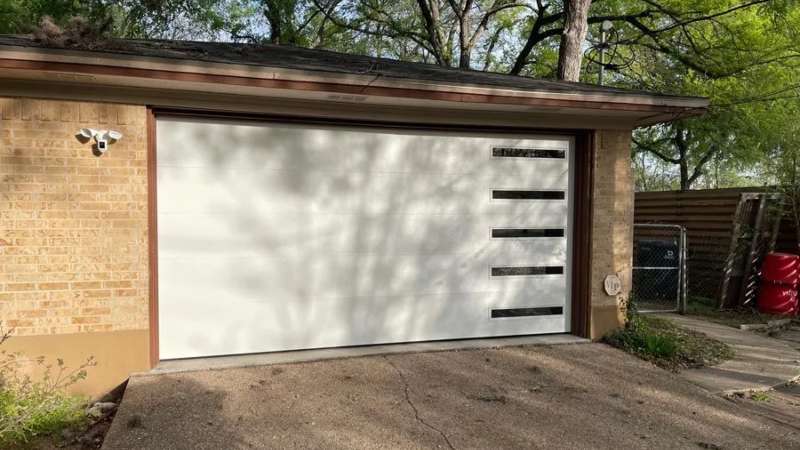
Every garage door reaches a crossroads eventually. The repair bills are adding up. The door looks tired. Something broke again. And the question that’s been hovering for months finally needs an answer: do you keep repairing this door, or do you replace it?
It’s a decision with real financial consequences in both directions. Replacing a door that still had useful life wastes money. Continuing to repair a door that’s in systemic decline costs more over time than replacement would have — and often means living with a door that’s less safe, less secure, and less energy efficient than it should be.
This guide gives you a clear, honest framework for making the repair-or-replace decision well — covering the financial analysis, the condition factors that matter most, the safety and security gaps that tip the scales, and the situations where replacement is obviously right and obviously wrong.
1. Start Here: The Questions That Frame the Decision
Before running the numbers, answer these five questions. Your answers will quickly indicate which direction makes more sense:
- How old is the door? A quality steel door can last 20–30 years with proper maintenance. If the door is under 10 years old and has had one isolated failure, repair is almost always right. If it’s 15+ years old with widespread wear, the calculus shifts significantly toward replacement.
- How often have you repaired it recently? One repair in five years is normal maintenance. Two or more repairs in three years is a pattern that indicates a system in decline. Recurring repairs on an aging door are a reliable predictor of more recurring repairs.
- Is the damage structural or cosmetic? A dented panel or a worn bottom seal is cosmetic or minor. A bent frame, widespread rust through the panel surface, warped sections, or a misaligned structure that no longer closes correctly is structural. Cosmetic damage favors repair; structural damage often favors replacement.
- Does the door have modern safety and security features? Auto-reverse function, photo-eye sensors, and rolling code opener technology are now standard and have been for decades. A door system that predates these features or has them in non-functional condition has safety and security gaps that favor replacement.
- Would a new door meaningfully improve the home? If the existing door is outdated in style, uninsulated on an attached garage, or visibly undermining curb appeal, the functional and financial benefits of replacement extend well beyond just fixing what’s broken.
2. The 50% Rule: The Most Reliable Financial Test
The most widely used financial rule of thumb in the garage door industry — and one that holds up well in practice — is the 50% rule: if the cost of repairs exceeds 50% of the cost of a comparable new door and opener, replacement is almost always the better financial decision.
Why the 50% threshold?
When you spend 50%+ of replacement cost on repairs, you’re making a significant investment in a system that’s already in its decline phase, without the benefits of a fresh warranty, new components, modern safety features, or improved energy efficiency. A new door at that price delivers all of those things — plus another 15–20 years of reliable service before the next major decision point.
How to apply it:
- Get a quote for the repair(s) needed
- Get a quote for a comparable new door and opener, installed
- If repair ÷ replacement > 0.5, replacement is the financially rational choice in most cases
- If repair ÷ replacement < 0.25, repair is almost always clearly right
The grey zone is between 25% and 50% of replacement cost — where the door’s age, condition, and the homeowner’s circumstances all factor in. A 12-year-old door needing $400 in repairs where replacement costs $1,200 might still be worth repairing once. The same repair on a 20-year-old door with rust and recurring problems tips toward replacement.
3. Component-by-Component: Repair or Replace?
Different failures carry different implications for the repair-or-replace decision. Here’s how to think about the most common ones:
Broken spring
Usually: Repair — Springs are the most commonly replaced component in any door system. A spring failure on an otherwise sound door is a routine repair, not a replacement trigger. The exception: if the door is 15+ years old, the opener is also aging, and the spring failure is accompanied by other visible wear, this service call is a natural prompt to evaluate the full system.
Snapped cable
Usually: Repair — Cable replacement is a standard professional repair. As with springs, both cables should be replaced simultaneously. A cable failure on an otherwise functional door is a repair, not a replacement trigger.
Single dented or cracked panel
Usually: Repair (if panel is available) — Individual panel replacement is cost-effective when the rest of the door is in good condition and a matching panel is still available from the manufacturer. The catch: older doors may have discontinued panel styles, forcing a full replacement to maintain visual consistency.
Multiple damaged panels
Often: Replace — Replacing two or more panels frequently approaches or exceeds 50% of a new door’s cost, especially when the door is older. Factor in the remaining panel availability, the door’s overall condition, and whether the repaired door will still look cohesive.
Widespread rust on steel panels
Usually: Replace — Surface rust that’s been touched up promptly is manageable. Rust that has penetrated through the panel surface, spread across multiple sections, or compromised the structural integrity of the panel is typically the point where replacement is clearly right. Patching deep rust is expensive and temporary.
Opener failure
Depends on age: An opener under 10 years old with an isolated component failure (stripped gear, failed sensor, faulty circuit board) is usually worth repairing. An opener over 10–15 years old, especially one without rolling code security, battery backup, or smart connectivity, is often better replaced than repaired — the repair restores function but doesn’t close the security and feature gaps.
Bent or misaligned tracks
Depends on severity: Minor track misalignment is a repair. Tracks that are significantly bent, cracked, or have pulled away from the wall mounting require replacement of the track sections, which combined with the underlying cause assessment may approach the cost point where a full door evaluation makes sense.
4. The Safety and Security Case for Replacement
The financial analysis doesn’t always tell the full story. There are situations where replacement is the right call not because of repair costs, but because the existing system has safety or security gaps that repairs won’t close.
Safety gaps that favor replacement:
- No auto-reverse function: Required by federal law since 1993. A door system without functional auto-reverse is a safety hazard that should be addressed regardless of repair cost.
- No photo-eye sensors: Also required since 1993. An older opener without sensors, or a door where sensors have been removed or disabled, is not up to current safety standards.
- Missing pinch-resistant panel design: Modern doors have panel designs that minimize the pinch hazard between sections. Older doors with deep panel joints present a greater entrapment risk for children’s fingers.
Security gaps that favor replacement:
- Fixed-code opener technology: Openers manufactured before the mid-1990s use fixed codes that can be intercepted and replayed by anyone with a code grabber device. This is a genuine, active security vulnerability — not a theoretical one.
- No battery backup: A door that can’t be controlled during a power outage is a significant vulnerability, particularly for homes where the garage is the primary entry point.
- Structural damage that compromises sealing: A door that doesn’t fully seal against the frame leaves gaps that can be exploited by determined intruders, regardless of the lock mechanism.
5. The Energy Efficiency Argument for Replacement
For homeowners with attached garages, energy efficiency adds another dimension to the replacement calculation that purely repair-focused analysis misses.
An uninsulated garage door has an R-value of approximately R-2. A quality insulated door reaches R-12 to R-18. For an attached garage, that difference translates directly into heating and cooling costs through the shared walls and ceiling. Homeowners upgrading from an uninsulated to an insulated door typically report annual energy savings of $100–$300 — savings that compound over the 15–20-year life of the new door.
When a door that needs significant repairs is also uninsulated, the replacement calculation should factor in those ongoing energy savings alongside the avoided repair costs. The combined case for replacement is often compelling even when the repair-only math might favor staying with the existing door.
6. The Curb Appeal and Home Value Factor
Garage door replacement consistently ranks among the highest-ROI exterior home improvement projects, frequently returning over 90% of its cost in added home value. This factor is most relevant in two situations:
- Planning to sell in the next 1–3 years: A new door improves listing photos, creates a stronger first impression for buyers, and reduces the likelihood of repair flags in a home inspection. The ROI on replacement is strongest when it directly influences a sale.
- Existing door significantly undermines curb appeal: An old, faded, dented, or stylistically mismatched door doesn’t just look bad — it actively undermines the perceived value of everything around it. A new door that complements the home’s architecture elevates the entire exterior. This benefit exists whether or not a sale is planned.
7. When Repair Is Clearly the Right Answer
Not every garage door problem calls for a replacement conversation. Here are the situations where repair is clearly the right call:
- The door is under 10 years old, in otherwise good condition, and has experienced a single isolated component failure
- The repair cost is under 25% of replacement cost
- The damage is cosmetic (minor dent, bottom seal, weatherstripping) and the structural system is sound
- The opener is modern, has rolling code security and battery backup, and is functioning correctly
- The door style and condition are appropriate for the home and the homeowner’s goals
8. When Replacement Is Clearly the Right Answer
And here are the situations where replacement is the clear choice:
- The door is 15+ years old with multiple failing components or widespread structural deterioration
- The repair cost exceeds 50% of replacement cost
- You’ve had two or more repair calls in the past three years
- The door has safety gaps — no auto-reverse, no sensors, fixed-code opener
- The door is uninsulated on an attached garage and energy costs are a concern
- Rust has penetrated the panel surface across multiple sections
- Replacement panels for the existing door style are no longer available
- A sale is planned within 1–3 years and the door is visibly aging or mismatched to the home’s style
Final Thoughts
The repair-or-replace decision is rarely as complicated as it initially feels. The 50% rule handles most cases cleanly. Door age and repair history handle most of the grey zone. Safety and security gaps, energy efficiency, and resale considerations cover the situations where the financial analysis alone misses the full picture.
When in doubt, get a professional assessment from a reputable local garage door company — not to sell you a new door, but to give you an honest evaluation of your current door’s condition and remaining service life. That information, combined with the framework in this guide, makes the decision straightforward More Read