

The industry-wide obsession with motion prompts has obscured a fundamental technical reality: generative video is only as stable as its static foundation. For performance marketers tasked with scaling AI video ads, the primary bottleneck isn’t the motion model’s complexity; it is the structural and lighting integrity of the source image. This source material dictates whether a video feels like a professional asset or enters the uncanny valley of melting limbs and flickering textures.
Achieving a predictable ROI in AI video production requires shifting the focus away from the “perfect prompt” and toward a “first-frame-first” workflow. In this approach, technical pre-processing of source assets prevents the temporal drift and hallucinatory artifacts that plague low-quality inputs. When the foundation is flawed, the most advanced motion algorithms in the world cannot save the sequence.
The ROI of Frame Zero: Why Pixel Stability Matters More Than Prompts
In a production environment, “rerolling”—the act of generating a video multiple times until the AI “gets it right”—is a significant drain on both time and compute credits. If 80% of video failures originate from a lack of clarity in the initial image, then the logical solution is to fix the image before the first frame of video is ever rendered.
Many creators overlook how motion models actually “see.” These systems do not understand physics in a traditional sense; they interpret pixel clusters and gradients. If a source image has muddy textures or ambiguous edges, the AI struggles to maintain those objects through 3D space. This is where we see backgrounds that begin to crawl or foreground objects that lose their shape.
The economic cost of these failures is compounded when working with high-efficiency models like Nano Banana Pro. While these models offer incredible speed and lower costs, they are also less forgiving of messy input data. A poorly composed source asset leads to “motion noise,” where the AI tries to animate artifacts it thinks are objects. By prioritizing high-fidelity depth and structural clarity in “Frame Zero,” teams can reduce their reroll rate by over 50%, directly impacting the speed at which they can iterate on ad creatives.
Lighting and Depth: The Silent Drivers of Motion Consistency
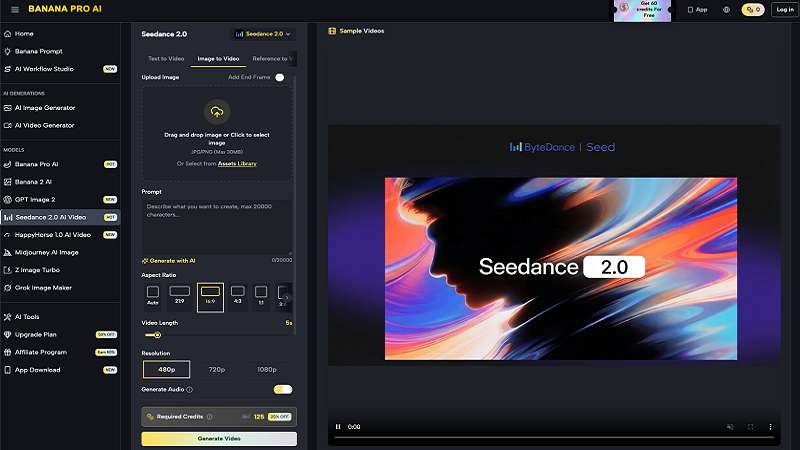
Motion consistency is largely a byproduct of how an AI model interprets lighting as depth. When using a tool like Banana AI to animate a still image, the model calculates the likely 3D geometry of the scene based on shadows and highlights. This is the difference between a video where a camera pans smoothly around a product and one where the product looks like a 2D sticker being pulled across the screen.
Flat images—those with even, unshadowed lighting—are a nightmare for generative video. Without contrast, the model loses track of object boundaries. For instance, if you have a white product on a light gray background with minimal shadowing, the AI may blend the two together during a pan or zoom.
To prevent this, performance marketers should focus on intentional composition that provides “anchor points.” High-contrast edges and clear light sources act as markers that the AI can track through a four-second generation. This isn’t just an aesthetic choice; it’s a technical requirement. By ensuring the source image has clear perspective cues—such as leading lines or a defined foreground-background relationship—you give the motion engine the data it needs to maintain temporal coherence.
The Pre-Production Pivot: Leveraging an AI Photo Editor for Video Readiness
The traditional workflow—generating an image and immediately hitting “animate”—is increasingly becoming obsolete for professional-grade content. Raw generations, even from high-end models, often contain structural clutter or subtle pixel noise that confuses motion vectors. This is where a dedicated AI Photo Editor becomes an essential component of the video pipeline.
Before a frame enters the motion stage, it should undergo a “cleanup” pass. This involves sharpening key focal points and removing “hallucinatory noise”—those strange artifacts that the human eye might miss but the AI motion model will amplify. Using the Canvas workflow in Banana Pro, creators can upscale specific regions, adjust local contrast to define edges, and ensure that the subject is visually distinct from the environment.
Transitioning from “image generation” to “asset preparation” is the hallmark of a mature AI creative operation. An AI Image Editor isn’t just for fixing mistakes; it’s for optimizing the technical data that the video model will consume. If the source asset is sharp and structurally sound, the resulting video is much more likely to maintain its integrity during complex movements.
Structural Anchors and Hallucinatory Drift in Nano Banana Pro
When working with Nano Banana Pro, the relationship between the first frame and the final output is even more critical. Because this model is designed for rapid iteration, it relies heavily on the “latent space” of the initial image to guide its path. If the perspective in the first frame is wonky—say, a table that doesn’t quite align with the floor—the AI will suffer from “hallucinatory drift.”
Hallucinatory drift occurs when the AI starts generating impossible physics to compensate for the perspective errors in the source. You might see a leg that starts to float or a wall that begins to bend. To mitigate this, focal points are key. By directing the AI’s attention to a clear, high-fidelity subject, you minimize the “background noise” that the model might otherwise try to animate unnecessarily.
It is important to set realistic expectations: there is a limit to how much “fixing” can be done once the motion sequence has already begun. While some tools allow for post-processing and interpolation, these are often just masks for poor source material. Starting with a frame that has been meticulously prepared in an AI Image Editor is always more efficient than trying to fix a flickering video in post-production.
Boundary Conditions: The Limits of Source Asset Correction
Despite the advancements in pre-processing, we must acknowledge that certain technical limitations remain. It is a common misconception that a perfect first frame can solve every problem in generative video. This is simply not true.
First, even a flawlessly composed image cannot compensate for fundamental model architectural gaps, particularly in complex human biomechanics. If you are trying to animate a person performing a complex, multi-joint movement like a backflip, the model’s internal understanding of anatomy often overrides the quality of the source frame. In these cases, the AI may still struggle with “limb blending” because it lacks the temporal training data for that specific movement, regardless of how sharp the starting image was.
Second, there is a point of diminishing returns when increasing source resolution. While a high-resolution frame provides more detail, if the underlying motion model only operates at a lower native resolution, the extra detail can actually create “high-frequency noise” that leads to shimmering or aliasing in the video.
Finally, there is an inherent uncertainty in current generative technology. Even with a perfect frame and a clear prompt, some generations will still fail due to latent space noise—random variations in the AI’s mathematical process that result in unpredictable motion. We are not yet at the stage of “one-click” perfection. Acknowledging these limitations allows marketing teams to build more robust workflows that account for the 10-20% of cases where the AI simply misses the mark, no matter how good the preparation.
By shifting the focus from “how do I animate this?” to “is this image ready to be animated?”, creators can move from a world of trial-and-error to a structured, repeatable production process. The first frame isn’t just the beginning of the video; it is the blueprint that determines whether the final product succeeds or fails More Read