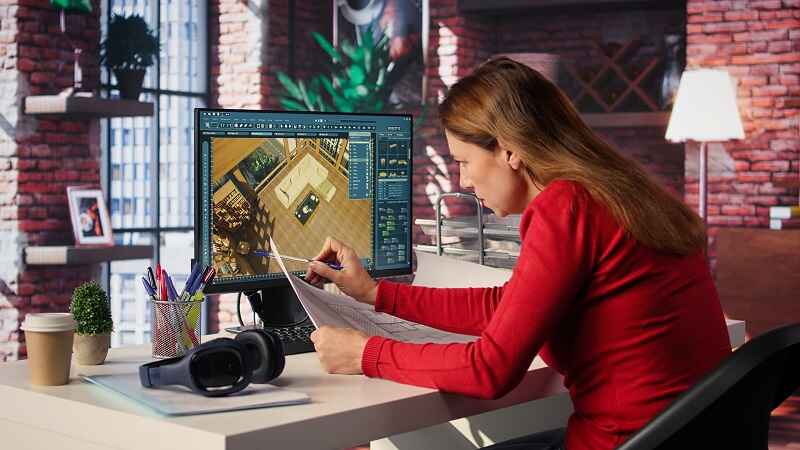
To an outsider, estimating a paint job seems like simple middle-school geometry: measure the length of the wall, multiply it by the height, and divide by the spread rate of the paint bucket.
But talk to any veteran commercial painting contractor, and they will tell you that the reality is a mathematical minefield. A commercial blueprint is not a blank canvas; it is a complex web of intersecting planes, varying substrates, and thousands of “voids”—doors, windows, and architectural openings that must be perfectly deducted.
For decades, estimators have tried to manage this chaos using legacy quantity surveyor software and manual click-and-drag digitizers. But as project timelines compress, the manual method is proving dangerously inadequate.
Today, the industry is undergoing a forced evolution. By integrating an advanced ai painting estimator, top-tier contractors are shifting from reactive square-footage guessing to mathematical certainty. Here is the operational truth about how artificial intelligence is systematically dismantling the hidden cost overruns in commercial painting.
The Illusion of the Square Foot in Commercial Painting
To understand the value of algorithmic precision, we must first dissect why legacy digital tools fail so spectacularly when estimating architectural coatings.
When human estimators use standard on-screen digitizers, they are forced to manually trace the perimeter of every single room to capture the gross wall area.
The “Gross vs. Net” Deduction Nightmare
The catastrophic danger of manual estimating lies in the negative space. You don’t get paid to paint the windows.
- The Voids: A modern commercial office building contains hundreds of floor-to-ceiling glass panes, massive double doors, and open archways. Manually drawing boxes around every single window to deduct that square footage from the gross wall area is agonizingly slow and highly prone to human error.
- The “Guesstimate” Risk: When pressed against a tight bid deadline, fatigued estimators often skip the exact deductions and simply guess an “average” deduction percentage for the floor. This leads to artificially inflated surface areas and massive over-ordering of expensive materials.
- The Complexity of Topography: Standard digitizers struggle with non-flat surfaces. Tracing the linear footage of baseboards, complex crown molding, and wainscoting requires meticulous, pixel-by-pixel clicking that drains an estimator’s bandwidth.
When you rely on basic 2D tools, your material calculations are nothing more than educated gambles disguised as data.
Enter the AI Painting Estimator: Mastering Negative Space
This is where true artificial intelligence fundamentally alters the preconstruction pipeline. An advanced ai painting estimator does not rely on a human tracing a line; it actively parses the geometric relationships embedded in the digital plans.
Algorithmic Surface Extraction
When you upload a complex architectural plan set into a modern AI platform, the machine learning engine actively reads the room schedules, elevation drawings, and floor plans simultaneously.
Automating the Unseen Details
Instead of a human clicking a mouse, the algorithm builds a hyper-accurate mathematical model of the paintable surfaces:
- Autonomous Void Subtraction: The AI automatically detects windows, doors, and architectural openings. It mathematically deducts these voids from the gross wall calculations instantly, delivering the exact net paintable square footage without a single manual click.
- Perimeter and Trim Detection: Advanced computer vision instantly traces the room perimeters to calculate the exact linear footage of baseboards, chair rails, and crown molding.
- Substrate Categorization: The software can cross-reference the architectural text notes to categorize the surfaces. It separates the smooth Level 5 drywall finish (which requires standard primer) from the porous CMU block walls (which require heavy block filler), allowing the estimator to apply the correct material costs immediately.
By handing the brutal geometric math over to the algorithm, painting estimators secure a mathematically flawless baseline of raw surface areas in seconds.
The Fluid Dynamics of Estimating: Spread Rates and Labor
A perfectly accurate surface area count is useless if it doesn’t translate into operational reality. The most successful painting contractors integrate their AI outputs with their broader quantity surveyor software to drive ruthless cost control.
Precision Material Factoring
Paint is a fluid, dynamic material. It does not go on the wall uniformly.
When estimators use legacy tools and guess their net square footage, they are also forced to guess their material orders. Because an ai painting estimator extracts a mathematically perfect net surface area, contractors can apply hyper-specific spread rates to the bid.
- Topcoat vs. Primer: The AI allows you to instantly calculate the varying spread rates of your materials. You can accurately forecast the gallons needed for a high-build primer versus the gallons needed for a premium eggshell topcoat.
- Waste Optimization: By knowing the exact net square footage, you eliminate the “just in case” padding. You order the exact number of five-gallon buckets required, eliminating the massive profit drain of leftover, unreturnable tinted paint sitting in your warehouse.
Hyper-Targeted Labor Allocation
The single largest variable in a commercial painting bid is labor. Rolling a massive, open warehouse wall takes a fraction of the time compared to “cutting in” around the intricate trim of a historic hotel lobby.
Because the AI separates the massive flat surface areas from the complex linear trim footages, estimators can apply different labor production rates to each category. This granular data ensures that your bid accurately reflects the precise man-hours required, rather than relying on a bloated “average” multiplier.
Surviving Architectural Addenda in Real-Time
The ultimate test of a contractor’s risk-mitigation strategy happens 48 hours before the bid deadline when the architect issues a revised drawing set.
Historically, when an addendum shifted walls or changed the window layouts, estimators scrambled to manually recalculate the massive shift in surface area. This panicked, chaotic rush guarantees missed scope.
Modern AI platforms neutralize this panic entirely. The software runs a pixel-by-pixel comparison between the original drawing and the revised addendum. It instantly generates a Variance Report, explicitly highlighting exactly what walls were extended, what doors were deleted, and how the net paintable square footage shifted. It acts as an unblinking safety net when human stress levels are at their highest.
Conclusion: Securing the Perfect Baseline
The commercial painting industry is too competitive, and material costs are too volatile, to continue relying on human visual endurance and bloated percentage guesses. The contractors who are dominating their local markets are no longer playing the “guesstimation” game.
By integrating specialized ai painting estimator platforms into their quantity surveyor software stack, estimators are shifting the burden of raw mathematical calculation to unblinking algorithms. They are securing a mathematically verified baseline that perfectly deducts negative space, precisely allocates complex labor rates, and totally eradicates material cost overruns. In a market where a single miscalculated floor can destroy your quarterly profit, algorithmic precision is the ultimate competitive advantage.