Key Takeaways
- By-product recycling is a core pillar of the circular economy, transforming waste materials into valuable resources and reducing reliance on virgin inputs.
- Recycling secondary materials conserves natural resources, lowers greenhouse gas emissions, and minimizes landfill waste.
- Businesses benefit financially by reducing disposal costs, improving energy efficiency, and generating new revenue streams from repurposed materials.
- Industries such as construction, electronics, and textiles demonstrate how diverse sectors can successfully reintegrate by-products into supply chains.
- Overcoming challenges like contamination, limited technology, and economic constraints requires innovation, policy support, and investment in advanced recycling systems.
Introduction
As society moves toward more sustainable solutions, the circular economy has emerged as a promising framework to counter the harmful effects of traditional linear consumption models. Unlike the linear approach that results in excessive waste, a circular economy centers on closing the resource loop and reducing environmental impact by reusing, refurbishing, and recycling materials. A key driver of this model is by-product recycling, in which waste generated during production or use finds new life in other applications rather than being discarded. For instance, many industries now focus on transforming waste into valuable resources, such as grease collected from commercial kitchens, which is processed and repurposed for biofuels or industrial applications.
With the growing urgency to conserve resources, reduce emissions, and eliminate pollution, by-product recycling plays a pivotal role. This method not only prevents unnecessary disposal but also stimulates resource efficiency, economic growth, and innovative manufacturing solutions that support sustainable development.
Understanding By-Product Recycling
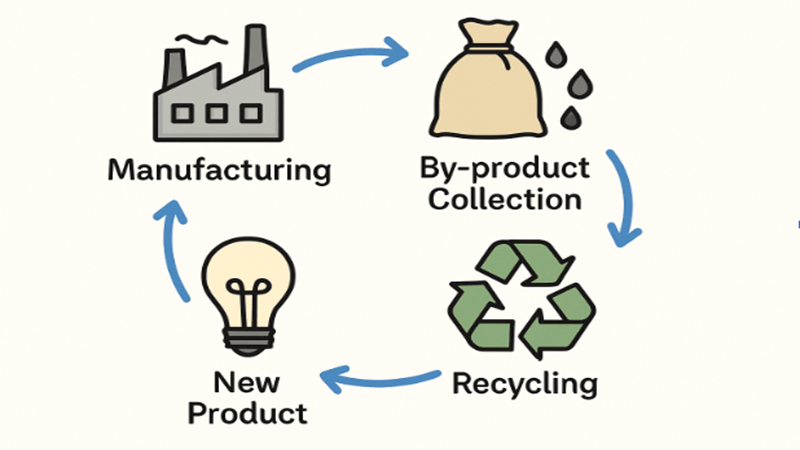
By-product recycling refers to the recovery and reprocessing of secondary materials generated during manufacturing or at the end of a product’s life cycle. Instead of viewing these materials as waste, industries treat them as potential inputs for new processes or products. For example, industries may capture excess heat from production lines to power nearby operations or use wood shavings from furniture manufacturing as raw material for particleboard. This closed-loop approach underpins the circular economy, enabling continual resource use with minimal environmental extraction or disposal.
Through effective sorting and processing, a wide range of by-products can be successfully reintegrated into supply chains, minimizing landfill use and curbing the demand for virgin resources. This shift to resource recirculation confronts wastefulness and underpins environmental responsibility.
Benefits of By-Product Recycling
- Environmental Conservation:Recycling by-products reduces the strain on ecosystems by limiting the need to extract raw materials. Forests, waterways, and wildlife habitats are preserved, and the volume of landfilled waste is significantly decreased.
- Economic Advantages: Utilizing by-products can reduce production expenses for businesses, lower waste management costs, and open new avenues for revenue by turning waste into marketable commodities.
- Energy Savings: In many cases, processing recycled materials requires less energy than extracting and refining virgin resources, contributing to notable reductions in greenhouse gas emissions.
Examples of By-Product Recycling
By-product recycling is practiced across diverse industries, highlighting its adaptability and potential for wide-scale implementation:
- Construction: The construction industry has embraced recycling by using crushed concrete from demolition sites as aggregate in new roadways and building foundations. This approach decreases reliance on newly mined materials and supports responsible demolition practices.
- Electronics: E-waste recycling has grown significantly in recent years, with valuable components and metals such as copper, gold, and palladium extracted from outdated devices. These recovered materials are utilized to manufacture new electronic products, reducing both raw material depletion and hazardous waste.
- Textiles: Used garments and textile scraps are processed and repurposed into fibers for insulation, automotive materials, and even new clothing. Brands and manufacturers are building business models that extend product lifespan and foster closed-loop textile supply chains.
Challenges in By-Product Recycling
Despite the clear advantages of by-product recycling, significant obstacles still exist:
- Contamination: Separating unusable materials or hazardous substances from by-products remains a complex issue. Poor waste segregation hinders recycling effectiveness and can increase costs.
- Economic Viability: For materials with low market value or when end products have little demand, recycling may not be financially sustainable without external incentives or support.
- Technological Limitations: Not all materials are currently recyclable with available technologies. Innovations in sorting, chemical recycling, and product design are required to unlock new recycling opportunities.
Strategies to Enhance By-Product Recycling
Addressing these challenges requires concerted strategies among industry players, policymakers, and researchers:
- Improved Sorting Technologies: Investments in advanced sorting and identification technologies can significantly reduce material contamination and increase the quality of recycled outputs. Deploying artificial intelligence and automation can further refine material streams and support large-scale recycling operations.
- Economic Incentives: Introducing financial incentives, tax breaks, or regulatory levers can encourage businesses to invest in recycling infrastructure and sustainable product design.
- Research and Development: Funding research to develop efficient recycling practices, new material recovery techniques, and eco-friendly product innovations can dramatically expand the range of recyclable by-products.
Case Study: RiverRecycle’s Impact
RiverRecycle stands as an innovative example of how by-product recycling can benefit the environment and local economies. Operating in diverse regions worldwide, the Finnish company targets plastic pollution in rivers. They collect, process, and transform river plastics into usable products, all while engaging local communities and strengthening circular economy practices. RiverRecycle’s model not only curbs plastic waste but also generates jobs and reinforces environmental awareness. Their work exemplifies how targeted recycling efforts can drive positive change at both ecosystem and societal levels.
Final Thoughts
By-product recycling is indispensable for advancing a circular economy that values materials, optimizes resource use, and fosters innovation. While the sector faces notable challenges in terms of contamination, costs, and technical constraints, strategic investments in technology, forward-thinking policy, and cross-sector collaboration can propel by-product recycling forward. By embracing these principles, businesses, governments, and communities can help build a more sustainable future, address waste problems at scale, and secure the environmental and economic well-being of future generations.