Your sales team closes deals when they know how to communicate, handle objections, and read customer needs. Without proper training, even talented salespeople struggle with pitches, fumble during negotiations, or miss buying signals completely.
But the good news is that companies across Singapore are investing in sales training to solve this problem. That’s why programmes like www.theatacademy.com design courses focused on building real skills rather than teaching theory. Their goal is to equip your team to perform better in real sales situations.
This guide covers the core skills every sales training program should include, the types of training courses available in Singapore, and how to build a program for your team. You’ll also learn practical steps to boost sales results and grow your business.
Ready? Here’s what you need to know.
Why Sales Training in Singapore Drives Business Growth
Sales training drives business growth by teaching your team the skills to close more deals, handle objections confidently, and build lasting client relationships.
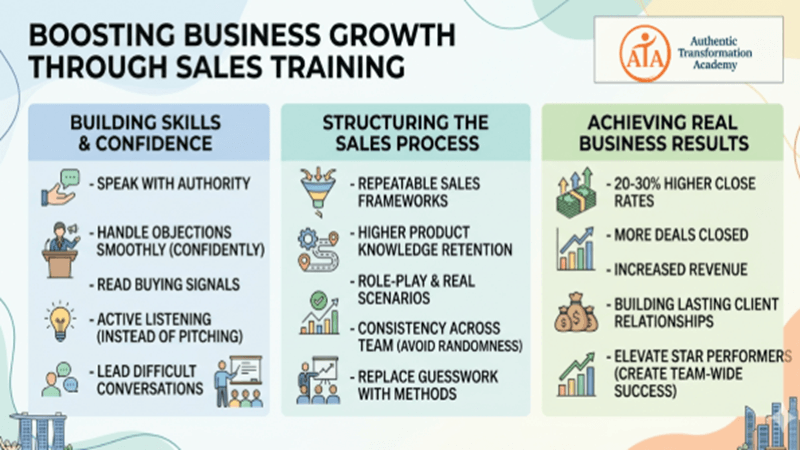
Considering how competitive Singapore’s market is, more companies have been investing in training courses because they provide real results. These programmes teach salespeople how to read buying signals, adjust their approach, and listen more carefully instead of simply pitching.
Now let’s break down those benefits in more detail:
Building Confidence in Sales Professionals
Sales training helps your team speak with authority during client meetings and presentations. Professionals learn to handle objections without second-guessing themselves or fumbling through responses. They even stop avoiding difficult conversations and start leading them.
Over time, you’ll notice these differences in their body language, tone, and how they carry conversations forward. Once we’ve watched one team member go from avoiding cold calls to leading client presentations in just weeks.
Real Results from Structured Training Programs
Companies in Singapore reported a higher close rate after implementing focused sales training courses. This improvement happens when teams replace guesswork with structured sales frameworks.
Beyond that, your team retains product knowledge better when training includes role-play and real-world scenarios. That’s why the sales process becomes more repeatable than being random.
This way, structured programmes create consistency across your sales force beyond just individual star performers.
Core Skills Every Sales Training Program Should Cover
Generally, good sales training courses focus on skills your team can use immediately. These aren’t vague concepts about mindset or motivation. We’re talking about communication techniques, understanding customer psychology, and knowing how to move people through the sales cycle without pressure.
However, training in Singapore often covers these two areas first:
Communication Techniques That Close Deals
Most salespeople think they’re listening, but they’re really just waiting for their turn to pitch. Active listening addresses this problem by helping sales professionals understand what clients actually need rather than just what they say.
In that sense, training teaches how to ask open-ended questions during sales presentations. These questions uncover pain points and buying motivations that customers might not volunteer. In addition, your team learns to present solutions in a language clients understand, which avoids jargon or technical overload.
Verdict: The ability to adjust communication styles based on the person you’re talking to makes all the difference in B2B sales.
Understanding Customer Psychology
Sales training covers why people buy based on emotion first, then justify with logic later. This perspective helps professionals understand the needs behind a client’s decision.
By understanding customer psychology, professionals even learn to read buying signals through verbal cues, body language, and silence patterns. This way, training builds trust quickly, and faster trust means shorter sales cycles and less client hesitation.
Once your team grasps this, you’ll see them slow down conversations instead of rushing to close. They will also focus on relationship building rather than just transactions. As a result, the sales objections they used to fear become opportunities to understand customer needs.
Types of Sales Training Courses: Finding the Best Fit
Modern sales training courses let you pick formats based on how your team actually learns and works. For instance, some sales teams need group energy and shared experiences. Others have specific gaps, like presentation anxiety or negotiation weakness.
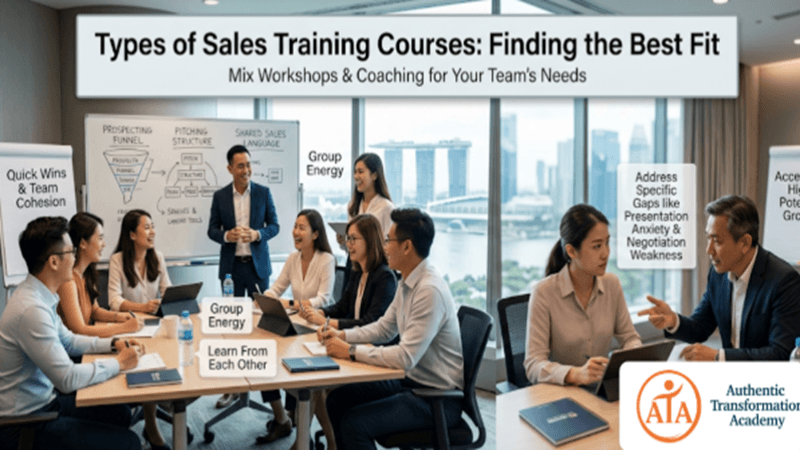
Considering these variations, the best training programmes in Singapore offer both workshop-based sessions and one-on-one coaching. As a result, you can mix formats based on your needs.
The following subsections make the difference clearer:
Workshop-Based Training for Your Team
Group workshops create energy and let your team learn from each other’s experiences and mistakes. These sessions work best for teaching foundational skills like prospecting, pitching, and follow-up techniques.
Additionally, companies in Singapore and across Asia often start here because it delivers quick wins without breaking the budget.
Group workshop formats also keep costs lower per person while building team cohesion and shared sales language. In fact, your salespeople will practice together, which means they can support each other after training ends.
One-on-One Coaching Sessions
Individual coaching addresses specific gaps like presentation anxiety, negotiation weakness, or closing hesitation. And the real shift happens when someone finally addresses the thing holding them back, not generic sales tips.
Beyond that, your sales professionals get personalised feedback on their unique style and communication patterns. Because coaches help them understand the sales process from their perspective, not a textbook model.
What’s more, coaching sessions accelerate growth for high-potential team members or those struggling with particular skills. For revenue-focused companies, this investment in sales representatives pays off through faster improvement and better customer service.
How to Build a Sales Training Program That Boosts Performance
Building a sales training program starts with assessing your team’s current skills, then designing targeted training courses addressing specific performance gaps.
Since you can’t fix what you don’t measure, you need to figure out where your sales force truly struggles. From there, you can build a program focused on real needs.
Here’s how to build a sales training program for your team:
- Assess Current Performance: Look at close rates, sales cycle length, and where deals fall apart. Your sales representatives might struggle with prospecting, handling objections, or closing. So, the data tells you where to focus training efforts.
- Choose Topics Based on Goals: If your company wants to grow revenue in B2B sales, your program should focus on relationship-building and stakeholder engagement. Plus, the training courses also need to align with the sales process your team actually uses.
- Mix Training Formats: Workshops teach foundational skills to everyone, while coaching addresses individual gaps. On the flip side, on-the-job practice helps people apply what they learn. However, our work with teams in New York and Singapore shows that programmes combining all three formats tend to deliver stronger results.
- Set Measurable Goals: Know how to measure success before training starts. Then, track close rates, sales cycle length, customer satisfaction, or revenue per sales professional. Here, the numbers show whether training actually works.
- Schedule Regular Refreshers: One training session doesn’t create lasting change. Here’s what we’ve noticed: teams training once and disappearing lose momentum within 60 days. That’s why schedule follow-ups every quarter to reinforce skills and address new challenges.
- Gather Team Feedback: Your salespeople know what’s working and what’s not. Ask them about the training courses, the ability to apply new skills, and whether the sales mindset shifted. Besides, use their input to make the program better over time.
Bottom Line: Building a sales training program in Singapore takes effort, but the payoff shows up in your team’s performance and your company’s growth. So, focus on practical skills, mix your training models, and keep refining based on results.
Ready to Transform Your Sales Team?
Sales training in Singapore gives your team the skills to close more deals, build stronger client relationships, and drive business growth. The right training courses also focus on practical abilities your sales professionals can use immediately.
Remember, your salespeople need consistent practice and real-world application to improve sales performance. Besides, companies investing in quality training programmes see better results, from shorter sales cycles to higher customer satisfaction.
The Authentic Transformation Academy helps teams develop the communication skills and sales mindset needed for success. Our sales training focuses on building genuine confidence and ability.
Explore our training courses and see how we can help your business reach its revenue goals.