
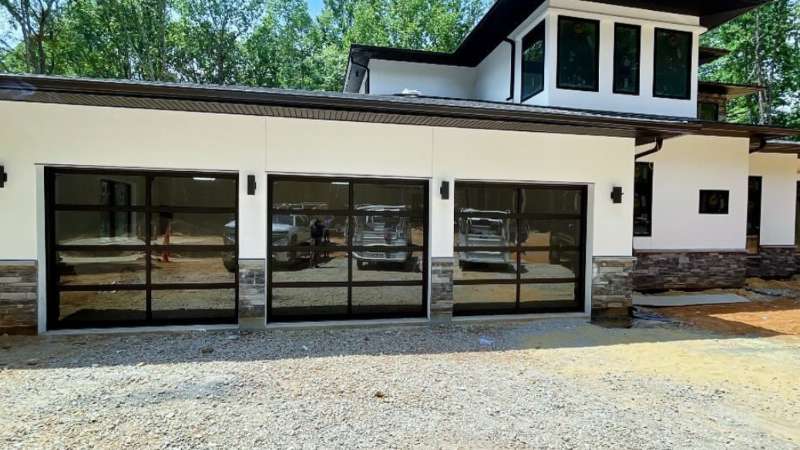
Garage doors come in two fundamental categories — residential and commercial — and the differences between them go far deeper than size. The materials, hardware, operators, cycle ratings, safety requirements, and maintenance needs of a commercial overhead door are fundamentally different from a residential garage door, even when the two look similar from the outside.
For homeowners, understanding these differences helps when a business use is involved — a home workshop, a home-based fleet vehicle, or a garage converted for commercial purposes. For business and property owners, understanding the differences prevents the costly mistake of specifying residential-grade components in commercial applications. And for anyone working with a full-service garage door expert who handles both, it explains why the approach, pricing, and components differ so significantly between a residential repair call and a commercial service contract.
1. The Fundamental Difference: Cycle Life and Duty Rating
The most important difference between residential and commercial garage doors isn’t visible to the naked eye — it’s the cycle rating of the components. A cycle is one open and one close. Everything in a garage door system — springs, operators, rollers, hinges, tracks — is rated for a specific number of cycles before it reaches end of service life.
Residential cycle ratings:
Standard residential torsion springs are rated for 10,000 cycles. For a household using the garage door four times per day, that’s roughly 6–7 years of service. A residential opener is designed for similar use — moderate daily cycles in a single-family home context. High-cycle residential springs (25,000–50,000 cycles) are available for heavy household use.
Commercial cycle ratings:
Commercial overhead door components are built for dramatically higher cycle counts. Commercial springs in high-use applications are rated for 100,000 cycles or more. Commercial operators are designed for continuous duty — opening and closing dozens or hundreds of times per day without the thermal overload that would shut down a residential opener under the same conditions.
Why this matters in practice: Installing residential-grade components in a commercial application doesn’t just void warranties — it creates a system that will fail on a compressed timeline under commercial use. A spring rated for 10,000 cycles that’s cycled 50 times a day reaches its rated life in less than a year. The repair cost of repeated failures far exceeds the original premium of specifying commercial-grade components.
2. Door Construction: Materials and Weight Classes
Residential and commercial doors are built differently from the ground up, and those construction differences reflect the demands placed on each.
Residential door construction:
Residential garage doors are typically constructed from 24–22 gauge steel, aluminum, wood, or composite materials in standard panel configurations. They prioritize aesthetics, insulation, and curb appeal alongside functional performance. Panel heights are standardized, and the door’s weight is carefully matched to spring specifications and opener horsepower ratings.
Commercial door construction:
Commercial overhead doors use heavier-gauge steel — often 24 gauge for standard commercial and up to 20 gauge or heavier for industrial applications. The panel construction is designed for structural performance under wind load, impact resistance, and thermal cycling. Commercial doors are available in significantly larger opening widths and heights than residential doors, and the track and hardware systems are proportionally heavier.
Specialized commercial door types:
- Rolling steel doors: Coil into a compact housing above the opening. Ideal for applications where maximum clear opening height is required or headroom is limited. Common in warehouses, parking structures, and service bays.
- High-speed doors: Open and close at 3–5 times the speed of standard doors. Used in high-traffic environments like food distribution, cold storage, and manufacturing where fast cycling reduces energy loss and improves workflow.
- Fire-rated doors: Required by code in many commercial and industrial applications. Automatically close in response to heat or smoke to compartmentalize fire spread. Must be annually tested and certified.
- Insulated sectional steel doors: The commercial equivalent of residential insulated doors — heavy-gauge steel panels with polyurethane or polystyrene insulation for climate-controlled environments.
3. Operators: Power, Speed, and Duty Class
The operator is the motorized system that powers door movement. The difference between a residential opener and a commercial operator is not just horsepower — it’s duty class, construction, and the entire design philosophy around how the system is expected to perform.
Residential openers:
Residential openers are rated in horsepower (typically ½ to 1.5 hp) and designed for light to moderate daily use. They connect to standard 120V household circuits. Modern residential openers include rolling code security, battery backup, smart home connectivity, and auto-reverse safety systems. They are sized for single-family home use and are not designed for continuous operation under sustained load.
Commercial operators:
Commercial operators are rated by duty class — light commercial, standard commercial, heavy commercial, and industrial — rather than simply by horsepower. They are built for continuous operation, handling higher door weights and more daily cycles without thermal overload. Heavy commercial and industrial operators often require three-phase electrical connections. The speed of operation is also a commercial differentiator — commercial operators cycle faster than residential openers, which matters in high-traffic applications.
Access control integration: Commercial operators routinely integrate with card readers, vehicle detection loops, intercoms, keypads, and building management systems — capabilities that residential openers don’t offer in their standard configurations.
4. Safety Requirements: Where the Standards Diverge
Both residential and commercial garage door systems are subject to safety requirements, but the scope and regulatory framework are different — and the consequences of non-compliance are significantly more serious in commercial settings.
Residential safety standards:
Residential garage door openers have been required by federal law since 1993 to include photo-eye sensors (mounted no more than 6 inches from the floor) and auto-reverse on contact. These systems must be tested monthly and verified to function correctly. UL 325 is the applicable safety standard for residential openers.
Commercial safety requirements:
Commercial overhead doors in workplace settings are subject to OSHA requirements in addition to UL 325 standards. This includes:
- Safety edges: Pressure-sensitive strips on the door’s leading edge that stop and reverse operation on contact — required in many commercial applications.
- Warning devices: Audible or visual warnings that alert workers when a door is about to operate.
- Vehicle restraints: At loading docks, vehicle restraints that secure a trailer to the dock during loading and unloading are required to prevent dangerous trailer creep or separation.
- Documentation: Safety inspections, fire door drop tests, and maintenance records must be documented for OSHA compliance and insurance purposes.
5. Maintenance: Frequency and Scope
The maintenance requirements for residential and commercial door systems differ significantly in both frequency and scope, driven by the difference in cycle counts and operational demands.
Residential maintenance:
Annual professional inspection is the standard recommendation for residential systems. Between professional visits, homeowners should perform monthly safety tests (auto-reverse and photo-eye), quarterly hardware tightening and track cleaning, and semi-annual lubrication. The goal is catching developing problems before they become failures.
Commercial maintenance:
Commercial door systems require significantly more frequent professional attention. High-use commercial doors may need quarterly or even monthly professional maintenance visits, depending on cycle count and application. Commercial maintenance programs typically include:
- Scheduled inspection and lubrication of all door systems and operators
- Safety system testing and documentation at every visit
- Fire door drop testing annually per NFPA 80 requirements
- Written condition reports identifying components approaching end of life
- Priority emergency response for program clients
The financial case for commercial maintenance programs is compelling: the cost of a failed commercial door — in lost productivity, emergency repair premiums, and potential OSHA compliance issues — significantly exceeds the cost of scheduled preventative maintenance.
6. When Residential and Commercial Needs Overlap
The residential/commercial distinction isn’t always clean. There are situations where a residential property has commercial-level demands, and where a commercial property has residential-style doors. Understanding the grey areas helps you make the right specification decisions:
- Home-based business with fleet vehicles: A residential garage used to store and access commercial vehicles multiple times per day has commercial-level cycle demands. High-cycle springs, a commercial-rated opener, and a heavier-gauge door should be specified even in a residential setting.
- Workshop or fabrication garage: A residential garage converted to a production or fabrication workshop with frequent vehicle and material movement may benefit from commercial-grade door specifications for longevity and reliability.
- Mixed-use or live-work properties: Properties that combine residential and commercial use require careful specification — the door serving the commercial portion needs to be rated for its actual use, regardless of the property classification.
- Small commercial properties with light use: A small retail space or office with a single overhead door used only a few times daily may be well-served by residential-rated components — the specification should follow the actual use pattern, not just the property type.
7. Working With a Provider Who Does Both
There’s a meaningful advantage to working with a garage door company that serves both residential and commercial customers. Providers who only do residential work may be unfamiliar with commercial specification requirements, safety compliance obligations, and the hardware differences that matter in demanding applications. Providers who only do commercial work may not have the range of residential products, style options, and aesthetic expertise that homeowners need.
A full-service residential and commercial provider brings several specific advantages:
- Correct specification from the start: A provider experienced with both categories knows when a situation calls for commercial-grade components in a residential setting — and won’t undersell you on components that will fail under your actual use pattern.
- Single-source accountability: For property owners with both residential and commercial doors to maintain — a homeowner who also owns investment or commercial properties, for example — one provider for all needs simplifies scheduling, billing, and relationship management.
- Code and compliance knowledge: Commercial safety compliance — OSHA, UL 325, NFPA 80 for fire doors — requires specific expertise. A provider who navigates these requirements regularly brings that knowledge to every commercial job.
- Emergency response across both: A commercial door failure at 10 PM and a residential spring break at 7 AM both require the same fast, competent response. A full-service provider is equipped for both.
Residential vs. Commercial: Quick Reference
Choose residential specifications when:
- The door serves a single-family home with standard daily use (under 10 cycles per day)
- Aesthetics and curb appeal are primary considerations
- Standard 120V electrical connection is available and adequate
Choose commercial specifications when:
- The door serves a business, warehouse, fleet garage, or high-traffic application
- Daily cycle count is 10 or more
- OSHA, fire code, or insurance compliance requirements apply
- The door opening is larger than standard residential dimensions
- Access control integration with card readers, loops, or building management is required
Final Thoughts
The residential/commercial distinction in garage door systems isn’t just a product category — it’s a specification framework that determines whether a system will perform reliably for its intended use or fail prematurely under demands it wasn’t built for. Getting this right at installation prevents the cascading costs of mismatched components, and maintaining the system correctly keeps it safe and operational for its full service life.
Whether you need residential service, commercial service, or a provider who handles both with genuine expertise in each, working with a full-service garage door company ensures you get the right specification, the right installation, and the right maintenance program for whatever your door actually needs to do.